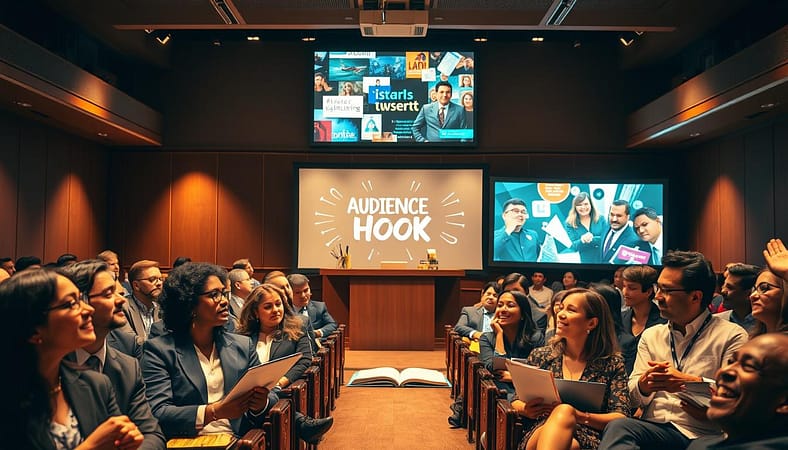
In today’s world, an introduction is more than just a hello. It’s like a hostage negotiation. You have only seconds to grab the reader’s attention.
If you fail, they’ll leave quickly. They’ll scroll away, lost in the digital sea. Imagine it like the first song at a concert. If it’s boring, people start checking their phones.
So, what do you need to do? A great introduction has four key tasks. First, you must grab their attention with a hook. This is like bait for a fisherman.
Next, you need to show them what they’ll get from reading. This is your value proposition. It answers the question, “What’s in it for me?”
Then, you build trust. Why should they believe what you say? Show your expertise right away. Lastly, give them a sneak peek of what’s to come. This is your roadmap.
Your goal is to turn a casual reader into an active participant. You’re making a promise from the start. It’s about turning a simple hello into a compelling journey.
Storytelling vs. Questions
Every exciting opener starts with something like “The clock struck midnight…”. But there are many that start with dull questions like “Do you like stuff?” This is a big choice for writers: to tell a story or ask a question.
Journalists love starting with questions to grab attention. But, most of these questions are as deep as a fortune cookie. “Do you like basketball?” or “Have you ever wondered about politics?” These aren’t compelling openers; they’re conversation killers. It’s like asking, “Do you breathe air?”
A good question should lead to a surprising answer. It should make the reader curious to find out more. Instead of “Do you like basketball?” try “What if the most important political deal was made on a basketball court?” The first question is simple. The second offers a story.
Storytelling is the novelist’s way to grab attention. It doesn’t ask for permission; it just starts telling a story. “My hands shook and beads of sweat rolled down my face as I attempted a simple task.” We don’t need to be asked if we’ve ever been nervous—we’re suddenly in the nervousness.
Our brains love stories, not questions. A scene makes us imagine. A weak question just makes us doubt. The smell of cigarettes, the light of a jack-o-lantern, or the fear of making lasagna for a critical mother-in-law—these details create a world. A generic question doesn’t.
So, when should you use each? Use questions when you’re explaining a complex idea. Use stories when you want to connect with the reader, set a mood, or show an idea through a real-life moment.
The wrong choice is disappointing. A personal essay that starts with “Have you ever felt sad?” is a waste. A policy analysis that begins with a long story about breakfast is also off track.
Your opening line is a promise to the reader. A question promises a puzzle to solve. A story promises something unforgettable. Make sure you can deliver what you promise.
Curiosity & Value Hooks
Storytelling and questioning are great, but there’s more. There are hooks that grab your attention and don’t let go. These hooks are what make a difference between a simple chat and a compelling headline.
The bold statement is like a loud statement that stops everyone. It says, “Everything you know about productivity is wrong.” It’s not just a way to grab attention—it’s a challenge to the usual ways of thinking. If done right, it attracts people who are ready for something new.
The relatable scenario is like a mirror that shows you’re not alone. It paints a picture that feels like it’s just for you. “You sit down at your desk, ready to tackle that project. Three hours later, you’ve done a lot of other things instead.” It says, “I see you,” and builds trust.

But, a hook alone isn’t enough. After grabbing your attention, you must show what you can do for them. Whether it’s a bold statement or a relatable story, you need to deliver value.
The key is to turn curiosity into action. A bold statement about productivity needs to be followed by real advice. A story about procrastination should offer a solution. This is how you keep your readers interested.
| Hook Type | Tone & Approach | Best For | Risk Level | Example Opening |
|---|---|---|---|---|
| Bold Statement | Confrontational, intellectual, challenging | Disruptive ideas, debunking myths, expert audiences | High | “Forget everything you know about time management.” |
| Relatable Scenario | Empathetic, narrative, inclusive | How-to guides, self-help, beginner-friendly content | Low to Medium | “If your to-do list gives you more anxiety than direction, you’re not alone.” |
| Value Promise | Solution-oriented, reassuring, direct | All content types (the essential follow-up) | Low | “This framework will cut your planning time in half.” |
The best openings mix disruption with direction. A bold statement grabs your attention, and a value promise shows the way. A relatable scenario creates a bond, and a value promise turns it into a shared goal.
Knowing how to transition from a hook to value is key. A great opening line is just the start. It must also show why staying with you is worth it. The true audience hook doesn’t just grab attention—it keeps it.
Formatting for Skimmers
Think about your introduction’s look as its first impression. A big, solid paragraph feels like a “Do Not Enter” sign. It’s scary and makes reading feel like a task.
We all scan quickly, like on social media or news feeds. Your intro should grab attention, not list everything. It’s like a strong invitation to keep reading.
The look of your introductions is key. It’s like the body language of your words. Using white space makes your ideas stand out. It’s like saying, “This is important.”
Don’t make your intro like a detailed list. It’s like reading the full terms and conditions. Instead, make it exciting, like a movie trailer.
So, what does a good intro for skimmers look like?
- Strategic White Space: Use breaks like cuts in a movie. They set the pace and guide the eye.
- Punchy Paragraphs: Keep each paragraph short and impactful. Aim for two to three sentences.
- The High-Concept Roadmap: Give a brief overview, not a detailed list. Make it enticing and build anticipation.
Good introductions respect the reader’s time and brain. They’re seen before they’re read. The layout either invites or intimidates.
Think of your introductions as teasers, not contracts. A good roadmap shows the beauty at the end and makes the journey worth it.
Formatting is not just for looks; it persuades. It turns reading into a choice, not a duty.
So, look at your intro. Does it say “come in” or “skip me”?
Real Examples
Enough theory. Let’s dive into the world of openers with a closer look. We’re going to explore how each one affects a reader’s brain.
First, let’s look at the anecdote. A business book starts with, “In 2008, a small startup was on the brink of failure…” This story is special. It shows a famous company’s (Airbnb) early struggles.
The hook grabs you because it turns success into a close call. It sets up a story that makes you want to know what happens next.
Next, we have the bold statement: “Everything you’ve been taught about productivity is wrong.” This statement challenges a common belief. It promises a fresh start, free from old, frustrating ways.
The choice of words—”everything,” “wrong”—is bold. It leaves no doubt about the change it offers.
The thought-provoking question from a religious guidebook asks, “If God spoke to you today, would you recognize His voice?” This question makes you think about your beliefs. It’s not about what you believe, but if you can recognize something important.
The question itself is the promise. It suggests the book will help you understand.
Lastly, the relatable scenario: “You sit down at your desk, ready to tackle that project…” We’ve all been there. It’s a common experience that makes you want to read on.
This scenario uses “you” and the present tense. It pulls you into the story. The promise is to help you break free from procrastination.
Let’s compare these openers to see how they work.
| Hook Type | Core Mechanism | Pivot to Promise |
|---|---|---|
| Anecdote (Business) | Creates dramatic irony (we know they succeeded) and immediate stakes. | Implies: “Here’s how they went from this brink to global dominance.” |
| Bold Statement (Self-Help) | Attacks a widely held belief to create a knowledge vacuum. | Promises: “I will fill that vacuum with a new, correct system.” |
| Provocative Question (Religious) | Personalizes an abstract idea, inducing self-reflection. | Offers: “The tools to develop that recognition you just doubted.” |
| Relatable Scenario (How-To) | Activates the reader’s own memory and frustration. | Guarantees: “A way out of this exact, maddening situation.” |
Looking closely at successful openers shows a pattern. It’s not just about being clever. It’s about creating a gap in the reader’s mind—like curiosity or doubt. Then, your book becomes the bridge to fill that gap. The best first lines are invitations, not just words.
Introduction to the Best Social Media Platforms
Social media has become a huge part of our lives, with billions of people using these platforms every day. It’s important to know which platforms are the most popular and what they offer. Let’s take a closer look at the top social media platforms and their unique features.
Facebook is the largest social media platform with over 2.7 billion monthly active users. It offers a wide range of features, including the ability to create and join groups, share photos and videos, and connect with friends and family. Facebook is a great platform for businesses to reach a large audience and build a community around their brand.
Instagram is a visually-driven platform with over 1 billion active users. It focuses on photo and video sharing, making it perfect for businesses in the creative and fashion industries. Instagram also offers features like Stories, Reels, and IGTV, allowing users to share their experiences and connect with their audience in different ways.
Twitter is a fast-paced platform known for its short-form posts called tweets. With over 330 million active users, Twitter is a great place for real-time conversations and news updates. It’s also popular for businesses to engage with their audience and share updates, making it an excellent platform for customer service and brand awareness.
LinkedIn is a professional networking platform with over 700 million users. It’s ideal for businesses looking to connect with professionals, find job opportunities, and showcase their expertise. LinkedIn offers features like LinkedIn Groups, LinkedIn Learning, and LinkedIn Pulse, making it a valuable platform for professional development and networking.
YouTube
YouTube is the largest video-sharing platform with over 2 billion monthly active users. It’s a great platform for businesses to create engaging video content and reach a wide audience. YouTube offers features like YouTube Premium, YouTube Music, and YouTube TV, making it a versatile platform for businesses to showcase their products or services.
These are just a few examples of the best social media platforms available today. Each platform has its own unique features and audience, so it’s important to choose the ones that align with your business goals and target audience.
| Platform | Monthly Active Users | Main Features |
|---|---|---|
| 2.7 billion | Groups, Photos, Videos, Events | |
| 1 billion | Photos, Videos, Stories, Reels, IGTV | |
| 330 million | Tweets, Hashtags, Direct Messages | |
| 700 million | Professional Networking, Groups, Learning | |
| YouTube | 2 billion | Videos, Premium, Music, TV |
Testing & Refining
Writing a first draft is like telling yourself a comforting lie. Revision is the uncomfortable truth serum. That initial burst of inspiration? It’s mostly ego. The real craftsmanship begins when you sober up and realize your brilliant openers need emergency surgery.
Our source nailed this paradox perfectly. “I am not the best hook writer,” she admits with disarming honesty, before adding, “Look I’m hilarious in person… I need to feed off others and their energy to be funny.” This isn’t weakness; it’s intellectual humility. She recognizes the gap between spontaneous wit and crafted prose. Your first draft is the version that makes you feel clever. The final version is what actually connects with readers.
Testing is where you bridge that gap. It’s the clinical trial for your verbal medicine.
The Two-Person Test
First, read your introduction aloud. To yourself. In a room. Does it sound like a TED Talk or a conversation with your smartest friend? If it leans toward lecture hall, you’ve lost the thread. Good openers have rhythm. They breathe.
Second, find your most critical, trusted reader. Not the one who says “I love it!” Give it to the skeptic. Ask one specific question: “At what exact point did you consider clicking away?” Their answer is pure gold. It shows where your promise faltered, where your energy dipped.
Refining is the art of subtraction. It’s killing your darlings—those witty asides that only you find funny. It’s sharpening vague promises into razor-edged commitments. Will your article “explore” an issue or “debunk” a myth? The verb matters.
Amplify your unique tone. Is your sarcasm too subtle for the skimmer? Is your analysis too dry for the casual reader? Our source’s self-deprecation about her writing humor builds trust. It says, “I’m not a performer; I’m a real person figuring this out.” That authenticity is a hook no perfect sentence can match.
This process separates competent openers from compulsive ones. It moves your work from “good enough” to “I need to share this.” Embrace the iteration. Your draft is a hypothesis. Testing and refining is the experiment that proves it true.
Conclusion
Your introductions are not just a simple handshake. They are the whole opening argument. Think of them as the thesis statement for your relationship with the reader. A weak start is like breaking a promise before the conversation even starts.
We’ve looked at what makes a great opening. From sparking curiosity to giving immediate value, the best introductions work like a master key. They grab attention, skip over doubts, and welcome the audience into your world. This isn’t about tricks. It’s about showing respect for your reader’s time and smarts.
As someone bluntly said, you need to “write an awesomesauce introduction.” That casual phrase actually holds a deep truth. Your opening paragraph should be essential, not just something you have to do. It should stand out because it makes everything that comes next clearer.
Don’t treat your first paragraph as just a warm-up. See it as the starting line. Use strategy, test your hooks, and refine with honesty. Your next piece deserves an introduction that doesn’t just tell—it convinces. Now, go create one.