

Organizing your website’s content around related search terms is more critical than ever. Google’s systems now evaluate your pages in the context of your entire site’s authority on a topic.
Relying solely on traditional methods, like grouping keywords that appear on the same search results page, is a blunt instrument. This old-school approach misses the deeper, conceptual connections between what users are actually looking for.
This is where modern, AI-driven semantic analysis changes the game. By using embeddings and NLP-based models, we can understand the true meaning behind search queries.
The software recognizes that “van conversion electrical system” and “solar panel setup for camper van” are fundamentally related, even if their immediate search results differ. This semantic understanding is the bedrock of building genuine topical authority, even in complex, competitive niches.
Mastering this strategic keyword clustering is no longer optional for SEO success. The following guide provides a clear, actionable pipeline to move from a messy CSV file to a clean, strategic topic map—all in a single afternoon.
Pipeline: collect terms → clean → embed → cluster → label
Turning hundreds of keywords into useful clusters isn’t magic. It’s a step-by-step process based on NLP. This method transforms a disorganized list into a clear topic map. Each step builds on the last, making a strong SEO base.
Start by gathering a wide range of terms. Aim for 300 to 500 keywords. Get them from your analytics, keyword tools, and competitor research. This initial list is your starting point.
Then, clean the data. This step is vital. Remove duplicates and terms that don’t fit your site’s focus. Also, standardize variations like “best running shoes” and “top running sneakers.” A clean list helps your clustering algorithm work better.
Next, use NLP to embed each keyword. Tools like Sentence-BERT or OpenAI’s models turn keywords into numerical vectors. These vectors show the meaning behind the words. For example, “vegan recipes” and “plant-based cooking” are seen as similar, even with different words.
This process lets machines understand term relationships. It’s like a bridge from words to logic.
With keywords as vectors, clustering starts. Algorithms like K-means group terms based on their meaning. Terms close together in vector space are clustered together. This creates groups where each term has a shared purpose.
The last step is labeling. Review each cluster and give it a clear, search-friendly name. For example, a cluster with “fix leaky faucet” and “dripping tap repair” could be labeled “plumbing repair guides”.
This label shapes your content hub’s theme. It guides your page title, meta description, and internal links. A good label is clear, actionable, and matches what people search for.
This entire process—collect, clean, embed, cluster, label—is a series of careful steps. Each step’s quality affects the next. Skipping any can weaken your SEO. The authoritative way is to follow each step carefully. This builds a topic map that truly reflects how your audience thinks and searches.
Quality Checks: silhouette score, manual spot checks, intent separation
Trusting an algorithm without checks is risky. Every cluster needs quality checks. Your AI has worked hard, but the topical clusters need your approval.
This step turns data into a reliable site map. You need a mix of math, human insight, and understanding search intent.
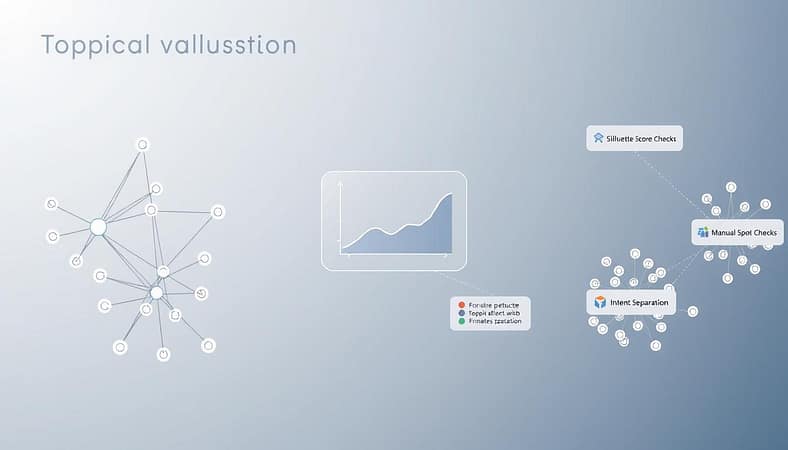
Begin with the silhouette score. It shows how well keywords fit their clusters. A high score means keywords match well.
The score ranges from -1 to +1. A score over 0.5 is good. A score near zero means clusters might need work.
Calculate the average score for all topical clusters. This first check shows if your clusters are healthy. A low average score means you might need to tweak your settings.
This score is a guide, not a final say. It points out areas that need more attention.
The Human Firewall: Manual Spot Checks
No number can replace human thinking. Manual checks are essential. You should review a few clusters randomly.
Open a cluster and check the keywords. Do they belong together? Would a searcher find the same page useful for all terms?
Watch for keywords that don’t fit. For example, “repair” in a “buying” cluster is a problem. This review catches things algorithms miss.
It makes sure your topical clusters make sense to people, not just machines.
The Critical Divide: Intent Separation
Intent separation is key. Search intent has three main types: informational, commercial, and transactional.
Mixing these in one cluster is bad. It leads to content that doesn’t satisfy anyone.
Informational keywords want to learn (“how to fix a leaky faucet”). Commercial keywords compare (“best kitchen faucet brands 2024”). Transactional keywords are ready to buy (“buy Moen faucet near me”).
Your checks must show these intents are separate. A common mistake is mixing “how to install a faucet” (informational) with “buy faucet installation kit” (transactional).
This mistake confuses users and search engines. It hurts your page’s ranking.
| Check Type | Purpose & Method | Key Insight & Ideal Outcome |
|---|---|---|
| Silhouette Score | Quantitative measure of cluster cohesion and separation. Use libraries like scikit-learn to calculate the average score for all clusters. | A score above 0.5 indicates well-defined clusters. A low score suggests you should revisit the number of clusters or the embedding model. |
| Manual Spot Checks | Qualitative review of logical grouping. Randomly select 5-10% of clusters and audit the keyword membership for thematic consistency. | Catches algorithmic oddities and ensures human-logical groupings. Outcome: High confidence that clusters reflect real-world topic associations. |
| Intent Separation | Ensures different user goals are not incorrectly merged. Manually tag sample keywords by intent and verify they reside in distinct clusters. | The cornerstone of usable topical clusters. Outcome: Pure informational, commercial, and transactional clusters ready for targeted content. |
Do these checks in order. First, the silhouette score gives a starting point. Then, manual reviews fix issues. Lastly, intent checks ensure your clusters are strategic.
This detailed process turns your clusters into a valuable asset. You’ll be confident in creating content that meets user needs.
Convert Clusters to IA: hubs/spokes, slugs, anchors, schema
Your labeled keyword clusters are the blueprint. The goal is to create a site architecture that search engines love. Turn your clusters into a clear hub-and-spoke model.
Make pillar pages your main hubs for broad topics. Create cluster pages for each subtopic as spokes. Plan your URL slugs to follow this hierarchy.
Use cluster-aware anchor text for internal linking. This passes authority and shows topical relationships to search crawlers. Strong internal linking helps Google understand your content’s structure.
Put schema markup on your cluster pages. Use types like Article, FAQ, or HowTo. This structured data helps search engines understand your content better. It can also boost visibility in rich results and AI-powered search overviews.
This structured approach builds a strong foundation for topical authority. Tools like Keyword Insights AI make the process easier. You go from a CSV file to a clear content ecosystem. Build a site that search engines understand and reward.