

Academic writing and online visibility are now linked. High-quality research papers are often found online. For example, an IGCSE Global Perspectives Individual Report can get noticed by search engines.
Search engine optimization is key for authority. These principles also apply to academic work seeking credibility and a wider audience.
A grading checklist based on on-page best practices is useful. It acts as a rubric for students to check their work.
This checklist improves a paper’s structure, sources, and presentation. Using it makes the work more professional. This leads to a stronger, more discoverable academic piece.
Pre‑publish: intent match, originality, citations (MLA/APA), E‑E‑A‑T cues
The pre-publishing phase is key for a paper’s credibility and findability. It involves several important checks that affect a work’s academic and online standing.
Intent match means the paper’s content must align with its main question. Today’s search systems, powered by AI, focus on complex, intent-driven queries. A student must make sure their thesis and arguments meet the reader’s information needs.
Originality is vital for academic integrity and digital content quality. It goes beyond plagiarism to include unique analysis and fresh perspectives. A paper must offer something new or a unique view of existing data.
Using MLA or APA citations is not just about style. It’s about trustworthiness. Proper citations show respect for intellectual property and let readers check claims.
These elements help build E‑E‑A‑T (Experience, Expertise, Authoritativeness, Trustworthiness). Search engines and academics use these cues to judge content value. A student can show these qualities through their work.
| E‑E‑A‑T Component | Student Application |
|---|---|
| Experience | Incorporate personal research, lab work, or case study analysis. |
| Expertise | Demonstrate deep understanding of the subject through accurate terminology and complex concept explanation. |
| Authoritativeness | Cite authoritative sources like peer-reviewed journals, reputable institutions, and recognized experts. |
| Trustworthiness | Ensure factual accuracy, provide transparent citations, and present a balanced, error-free manuscript. |
Following these pre-publish standards boosts a paper’s content quality. It turns a simple assignment into a credible, valuable piece. This foundational work is key for a high grade and strong online presence.
The move to intent-based evaluation makes keyword use less effective. A paper must solve a specific problem or answer a clear question. Strong eeat signals come from thorough research and ethical writing, not shortcuts.
Core elements: title, URL, H1–H3, intro hook, conclusion CTA/resource
Good academic papers have key on-page elements that help readers understand and find them. A detailed on-page SEO audit looks at these parts. They are important for both people and machines to understand the paper.
The title is the most important part of the metadata. It should be short and clearly state the paper’s main idea. The filename is also important, acting like a URL in digital systems.
Filenames should be clear and use hyphens to separate words. For example, “on-page-seo-audit-checklist.pdf” is better than “final_paper_v2.docx”. This makes it easier to find and organize.

Heading tags help organize the paper’s structure. The main title is an H1. This gives a clear label for the whole paper.
Major section breaks are marked with H2 tags. Subsections use H3 tags. This makes it easy to follow the paper’s flow.
A strong intro hook is essential. It should clearly state the paper’s purpose and why it matters. It sets up the research question or problem.
The conclusion must end with a strong statement. In academic papers, this means summarizing the findings. It should also suggest what to do next.
Steps might include more reading or research. They can also talk about the bigger picture of the work. This shows a complete analysis.
These core parts are key to how content is understood. This is true for both old search engines and new AI systems. A careful on-page SEO audit makes sure each part does its job well.
Every part, from title to conclusion, works together. They make a clear and findable academic paper. Doing these elements well is the foundation of a well-made academic submission.
Media: images optimized, captions, alt text, figure numbering
Every image, chart, or graph in academic work must meet certain standards. Optimized media boosts a paper’s credibility and supports its arguments visually. It also makes sure the content is accessible to all and loads quickly on any platform.
First, file optimization is key. Images should be in formats like JPEG for photos or PNG for graphics with text. The goal is to keep quality high while keeping the file size small for fast loading. Big, unoptimized files can slow down documents and annoy reviewers.
Descriptive captions are a must for all visuals. A caption should briefly explain what the media shows and its relevance to the text. This turns an image into evidence that supports the paper’s main point.
Alt text, or alternative text, is also very important. It gives a text description of an image for screen readers used by people who can’t see. Good alt text is short but clear, accurately describing the image’s content and purpose.
Media should be organized well with the document’s structure. All figures and tables need consistent figure numbering, like “Figure 1,” “Figure 2,” etc. Each media piece must be referenced by its number in the main text. This makes the narrative flow clear and professional.
The following table outlines the core components of media optimization for academic papers:
| Media Component | Optimization Action | Primary Benefit |
|---|---|---|
| Image File | Compress to reduce file size; use appropriate format (JPEG, PNG). | Ensures fast loading and easy sharing. |
| Caption Text | Write a brief, descriptive explanation linking media to argument. | Clarifies relevance and strengthens evidence. |
| Alt Attribute | Provide a concise, accurate description of the visual content. | Guarantees accessibility for all users. |
| Figure Numbering | Assign sequential numbers (Figure 1, Table 2) to all media. | Enables clear organization and referencing. |
| In-text Reference | Mention the figure or table number when discussing it in text. | Integrates media seamlessly into the narrative. |
Following these standards makes visual aids useful, not just for show. Properly optimized images with accurate captions and alt text improve a paper’s quality score. They show thoroughness and respect for the reader’s experience, key to top-notch academic work.
Links: internal links to pillar/refs; 2–4 trustworthy external citations
Just like a website gains authority through links, a research paper gets credibility from internal and external references. This structure helps the reader follow along and strengthens arguments with solid evidence.
Internal links guide the reader through the document. They point to key arguments, data, or definitions found elsewhere. Good cross-references, like “as analyzed in Section 2.1” or “refer to Figure 4,” make the narrative flow smoothly. They help readers check claims and grasp the paper’s layout without seeing the same information twice.
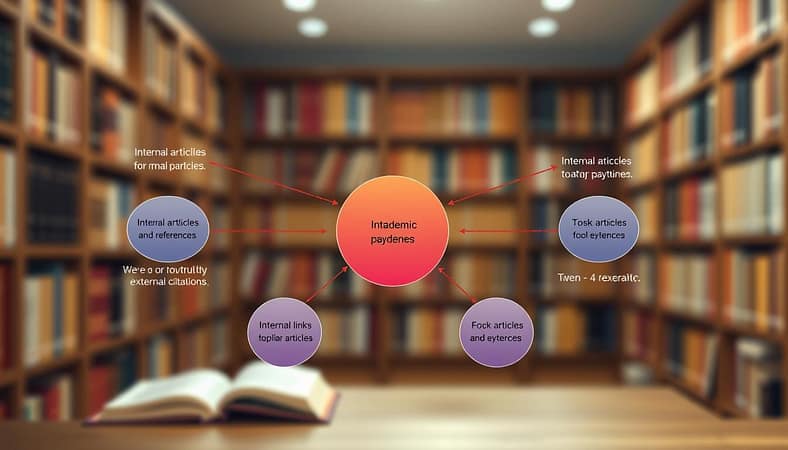
For each major point, the paper should have 2–4 trustworthy external citations. Quality is more important than quantity. These references should come from reliable, peer-reviewed sources. Using such sources boosts the paper’s authority and follows the on-page SEO principles of gaining trust through credible backlinks.
Using both internal and external links is key. The table below shows their roles and best practices.
| Link Type | Primary Function | Key Consideration | Academic Example |
|---|---|---|---|
| Internal Links | Guide reader to related sections within the paper | Use clear signal phrases for navigation | “This method is detailed in the Methodology section.” |
| External Citations | Substantiate claims with external authority | Prioritize peer-reviewed journals and primary sources | “Recent studies confirm this trend (Jones & Lee, 2022).” |
This method makes sure the paper is both clear within itself and backed by outside evidence. It turns a bunch of statements into a solid, believable academic piece.
Readability: sentence length, transitions, scannable bullets/tables
Readability makes complex academic info easy to understand. It works for both human readers and AI tools. Readability is key for success in school and online.
It’s important to keep sentences short. Long sentences can hide the main point. Try to mix up sentence types, but always keep it clear. If a sentence has more than 25 words, it’s best to break it into two.
Transitions help readers follow your argument. Words like “furthermore” and “in contrast” show how ideas connect. They make your writing flow smoothly.
Bulleted lists and tables make complex data easy to scan. They help readers quickly grasp important points. This is a big help when you’re reviewing many papers.
| Evaluation Criteria | Dense Paragraph | Scannable Element (List/Table) |
|---|---|---|
| Comprehension Speed | Slow; requires full reading | Fast; key points are instantly visible |
| Argument Clarity | Can be obscured by text walls | High; each point is isolated and emphasized |
| Algorithmic Parsing | More challenging for AI to extract structure | Easy; clear data relationships are defined |
To make your paper easier to read, try these tips.
- Shorten sentences with many clauses.
- Use transitional words to connect paragraphs.
- Turn lists or data into bulleted lists or tables.
- Use headings to organize your text.
Technical: mobile check, speed, schema basics, 404/redirect sanity
A on-page SEO audit checks technical aspects of a website. For students, this means making sure their work is easy to read and looks good. It’s like checking if a website works well, but for school papers.
The “mobile check” means your paper should look good on any device. Check if your paper looks right on different PDF viewers and devices. Make sure margins, fonts, and images stay the same on laptops, tablets, and phones.
“Speed” is about keeping your file small. A big file can slow down email or fail to upload. Use small images and standard fonts to keep your file size down.
“Schema basics” mean using clear formatting. This makes your paper easy to read and understand. Use styles for headings, quotes, and captions to keep things consistent.
The “404/redirect sanity” check is about checking links. Make sure every link you use works. Broken links can hurt your paper’s credibility, just like a bad website.
| Website Technical SEO Factor | Document Preparation Equivalent | Student Action Item |
|---|---|---|
| Mobile Responsiveness | Cross-Device Readability | Test PDF on phone, tablet, and computer. |
| Page Load Speed | Optimized File Size | Compress images and save in a web-friendly format. |
| Structured Data (Schema) | Consistent Formatting Styles | Use “Heading 1,” “Heading 2,” and “Quote” styles in word processor. |
| Broken Link Check | Reference & Hyperlink Validation | Click every link in the document to ensure it works. |
| Core Web Vitals | Submission Readiness | Ensure the final file opens instantly and prints correctly. |
These steps are key to a good on-page SEO audit. They make sure your document looks and works well. Just like websites, poorly formatted papers can lose points.
Doing these technical steps shows you care about your work. It means you know good content needs good presentation. A well-prepared paper lets your research shine.
Post‑publish: analytics setup, annotate updates
The on-page SEO process doesn’t stop after you submit your work. It moves into a critical evaluation phase. This stage is all about measuring how well your work did and how it improved.
Setting up analytics starts with getting feedback from your instructor. Grades and comments are key metrics. For work on sites like WordPress or Google Scholar, tracking views and engagement is also important. This data shows how many people saw and interacted with your work.
Then, you make updates to your document. You note any changes, add new sources, or address feedback. This makes your work’s development clear and open.
It shows you’re serious about getting things right and learning more. An updated version makes your work stronger for future use or more research. This process follows SEO principles, but for academic work.
Adding a simple routine after publishing completes the SEO process for students. It turns a single piece of work into a valuable, dynamic resource.